Measuring Success in Influencer Marketing
Knowing whether an influencer marketing campaign is working isn’t about counting likes or watching followers tick up. As influencer marketing becomes more embedded in serious marketing strategies, brands need better tools, smarter thinking, and a refined approach to measuring what matters. We believe that tracking the impact of influencer marketing isn’t just a technical task – it’s central to making the channel work long-term.

Setting Smarter Goals and KPIs
All measurement starts with a purpose. If you’re not clear on what you want from an influencer marketing campaign, you won’t know whether it’s working. That’s why clear goal-setting – tied directly to your wider marketing strategies – is the foundation of everything else.
Whether your aim is to increase brand awareness, generate leads, or drive purchases, each objective needs matching key performance indicators (KPIs). These might include an uplift in search interest, website traffic from influencer content, or redemptions of campaign-specific discount codes.
Some of the most valuable performance signals include:
- Click-throughs from tracked links
- Uplift in branded search or direct traffic
- Conversions from promo codes
- Qualitative feedback in comments
- Content saves or shares (a strong indicator of perceived value)
Also, consider wider effects: does the campaign increase media attention, encourage user-generated content, or drive new followers to your brand’s profile?
Define clear goals from the outset – whether it’s awareness, conversions, or product trial – and make sure your metrics reflect them.
From Metrics to Meaning
Plenty of influencer campaigns generate large numbers – impressions, likes, views. But what do they actually tell us? In isolation, not much. Instead of collecting data for the sake of it, we need to focus on what these numbers mean in context.
Engagement rate remains one of the most useful indicators. But instead of applying a single benchmark, we account for platform norms, content types, and influencer tiers. A 4% engagement rate might be exceptional on YouTube but average on TikTok. It all depends on audience behaviour and campaign design. The below table shows engagement rates across different social media platforms in Q1 2025 (Hootsuite).
| Average Engagement Rates on Social Media in Q1 2025 | |
|---|---|
| Platform | Engagement Rate |
| 3.4% | |
| 1.3% | |
| 2.8% | |
| TikTok | 1.5% |
Matching Metrics to the Funnel
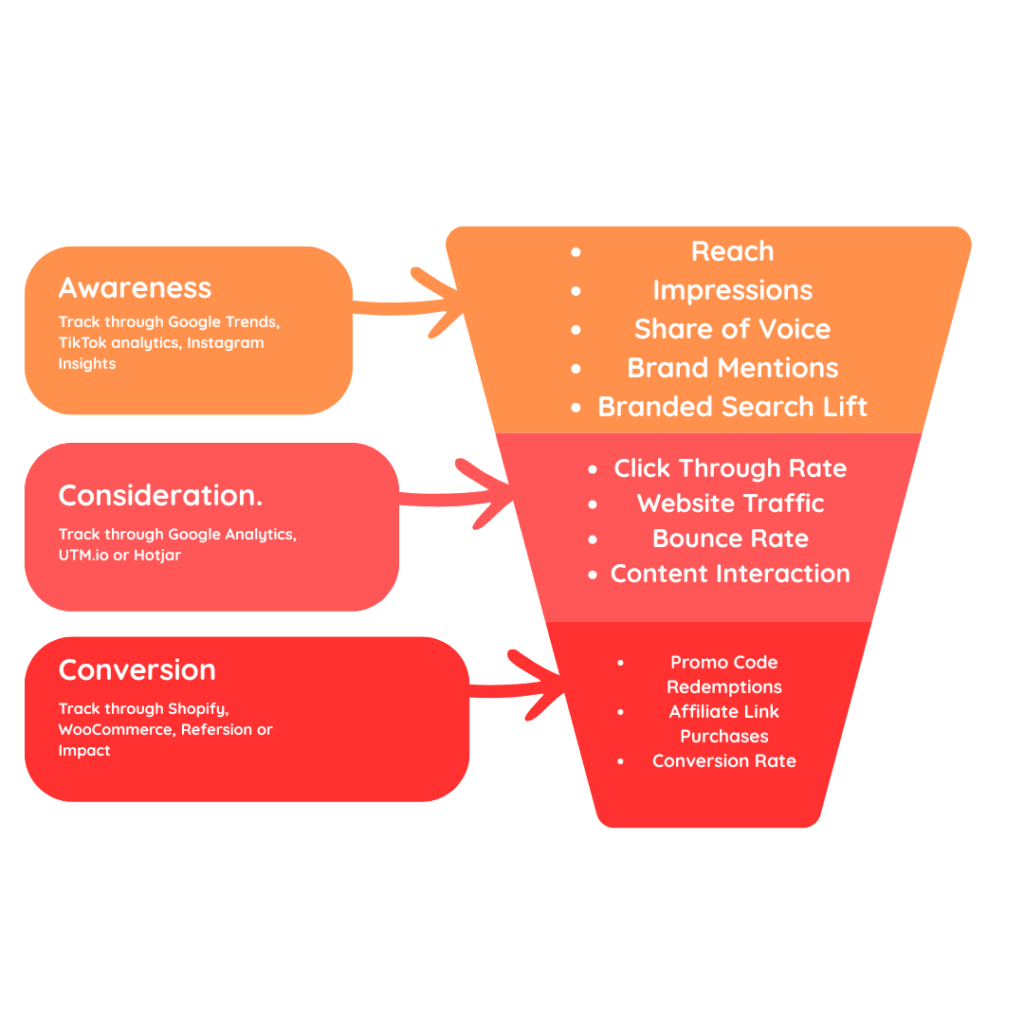
To measure the impact of influencer marketing in a meaningful way, we track different types of results at different stages of the funnel.
At the awareness stage, we assess reach, impressions, and share of voice. Brand mentions – both tagged and untagged – help us understand whether influencers are starting real conversations. A spike in branded search queries can signal increased curiosity driven by influencer exposure.
During the consideration phase, we shift focus to behaviours that show intent. We use tools like Google Analytics to monitor website traffic driven by social media, especially click-throughs from Stories, Reels, or influencer bios. We also track time spent on site, bounce rates, and content interaction.
When it comes to conversions, we look at actual results – sales, sign-ups, downloads – and trace them back to influencer touchpoints. This includes discount code redemptions, affiliate link clicks, and conversion tracking through dedicated landing pages. If an influencer’s audience lands on your site but doesn’t act, that’s still useful data. It could point to misaligned messaging, unclear calls to action, or poor post-click experiences.
Understanding Individual Influencer Impact
Not all influencers are created equal. That’s why it’s crucial to go beyond averages and evaluate performance at an individual level.
We look at each influencer’s true reach – the actual number of people who saw the content – alongside their engagement rate and the nature of their audience interactions. Did their followers show genuine interest? Did the content feel authentic or scripted? These details shape how we assess long-term potential.
Influencer marketing success isn’t only about performance. It’s about fit. If someone has a moderate reach but consistently drives relevant traffic and strong engagement, they may offer more value than a creator with larger numbers but lower relevance to your target audience.
Over time, these insights help build stronger partnerships and better briefing strategies. Knowing which creators deliver – and why – is essential to improving marketing campaigns over time.
Making ROI Workable
Calculating influencer marketing ROI isn’t straightforward – especially when content can influence behaviour across multiple touchpoints. But that doesn’t mean it’s impossible.
We start with clarity on costs. That includes creator fees, product seeding, shipping, platform or agency expenses, and internal team time. Once we’ve established the outlay, we match it with campaign returns: direct conversions from links or codes, overall uplift in relevant KPIs, and even indirect value like content reuse or audience insights.
To fill in the gaps, we may use earned media value (EMV). EMV estimates how much it would cost to achieve the same reach and engagement through paid ads. While not a replacement for ROI, it provides a useful way to contextualise influencer performance against other marketing channels.
The Right Tools for Advanced Measurement
As campaigns scale, tracking results across platforms becomes more complex. Manual methods may work for one-off projects, but long-term influencer programmes need smarter systems.
Google Analytics remains vital for measuring the link between influencer content and website traffic or conversions. However, we also rely on social media listening tools to monitor brand sentiment and detect spikes in mentions, especially those outside direct tagging.
Influencer platforms offer performance dashboards that help track engagement rate, reach, and conversions. When integrated properly, they allow us to compare creators, content formats, and even campaign performance across markets.
What matters most is not just collecting data – it’s making sense of it. That’s where unified reporting and clear visualisation tools become essential. If you can’t quickly identify what’s working, you’ll struggle to make confident decisions.
Conclusion
Measuring the success of influencer marketing is about more than counting likes or tracking surface-level numbers. Real impact comes from connecting goals with meaningful metrics, understanding how different influencers contribute at each stage of the funnel, and recognising the long-term value of authentic partnerships.
By combining clear KPIs with smarter analysis, brands can see beyond vanity metrics and focus on the outcomes that matter most: awareness, engagement, and conversions. When data is contextualised and tied back to strategy, influencer marketing stops being guesswork and becomes a reliable driver of growth.
If you haven’t yet, take a look at part one on building influencer relationships and part two on influencer gifting and personalised outreach to see how each stage works together to create a stronger, more effective influencer strategy.